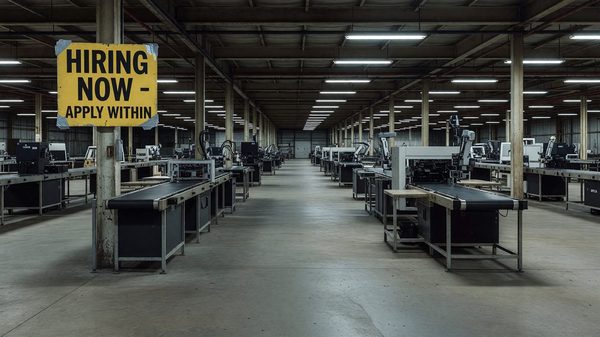
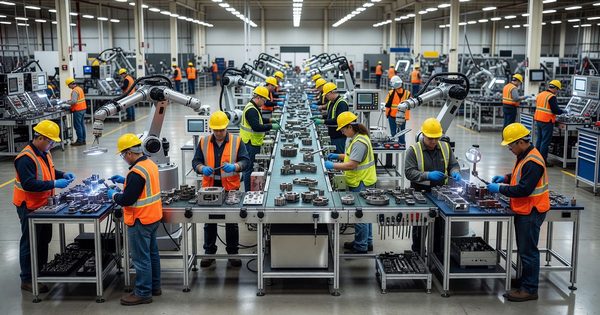
Domestic supplier pitches have converged on a single claim: automation closes the cost gap. It is a reasonable claim in the aggregate — North American companies ordered 8,940 robots valued at $622 million in the second quarter of 2026, bringing first-half totals to 17,995 units and $1.166 billion, according to the Association for Advancing Automation. Units were up 2.0% and order value up 6.6% against the first half of 2025.
What the aggregate does not tell a buyer is whether the specific plant quoting your part has automation that meaningfully affects its cost structure, or a demonstration cell that appears in the plant tour and nowhere in the process flow. Those two suppliers make the same claim in an RFQ response. Separating them is a vetting problem, and it is answerable with questions that do not require an automation background.
Why the Distinction Has Sharpened
The A3 data shows something more useful than growth: demand has broadened well past automotive. Automotive OEM orders fell 25% in the first half of 2026 versus the same period in 2025, while semiconductors and electronics rose 35%, pharmaceuticals 32%, automotive components 24%, food and consumer goods 17%, and plastics and rubber 6%. Collaborative robots accounted for 2,774 units, or 15.4% of total orders.
Two things follow for a buyer. First, general-industry suppliers in your category plausibly do have new automation, because that is where the growth went. Second, collaborative robots at 15% of orders means a meaningful share of new installations are lower-throughput, human-adjacent cells rather than high-volume hard automation — which is a legitimate configuration with very different economics from what “automated line” implies.
The constraint that trips up domestic capacity is not the robot. It is the technician. Automation and controls engineering — PLC programming, SCADA design, robotics integration — is consistently reported as among the hardest roles to fill in reshored operations. A supplier can buy a cell in a quarter and struggle to staff it for a year. That gap is where delivery risk actually lives, and it is invisible in a capabilities deck.
Six Questions That Separate Real From Staged
None of these require you to evaluate the equipment. They ask the supplier to produce evidence that automation is load-bearing in their operation.
1. Which specific operations on our part run through automated equipment, and which are manual? Ask for it as a marked-up process flow, operation by operation. A supplier running genuine automation on your part answers this in a sentence. One that cannot produce the routing distinction is describing plant capability rather than your part’s actual path.
2. What is the utilization on that cell, and what else runs on it? A cell dedicated to one high-volume program behaves differently from one shared across fourteen part numbers with changeover between each. Shared cells are fine — often better capital discipline — but they make your delivery dependent on a scheduling queue you cannot see. Ask what your part’s position in that queue is when the plant is at capacity.
3. Who programs and maintains it, are they employees, and what happens when that person is out? This is the technician question in a form a supplier will answer concretely. “Our integrator supports it under contract” is a real answer with a real response time attached — ask for the SLA. “One person who has been here twelve years” is also a real answer, and a single-point-of-failure you should price.
4. Show me changeover time and first-pass yield before and after the installation. Automation that matters shows up in these two numbers. If a supplier installed a cell eighteen months ago and cannot produce a before-and-after on setup time or scrap rate, either the data does not exist — which tells you about their process discipline — or the change was not material.
5. What does your quoted price assume about volume, and what happens to it at half that volume? Automation converts variable labor cost into fixed capital cost. That is the entire economic argument for it, and it cuts both ways. A quote built on an automated cell amortized across projected volume degrades faster on the downside than a labor-based quote does. Ask for the price at 50% of forecast. A supplier who has thought about their own cost structure has this number.
6. What is your lead time on the equipment itself, if you need to add capacity? The July 2026 ISM Manufacturing PMI put average commitment lead time for capital expenditures at 172 days, up one day from June. If your supplier’s growth plan depends on adding a second cell, that is roughly six months of lead time before installation, commissioning, and staffing. Any capacity commitment beyond current installed base should be dated against that.
What to Verify On Site
A plant visit is worth structuring around three observations rather than a tour.
Watch a changeover on the cell that runs your part. Not a demonstration — an actual production changeover, timed. This single observation resolves most of what questions two and four are trying to establish.
Look at what is running while you are there. An automation investment that carries a plant’s cost structure is running. Equipment that is idle during a scheduled customer visit is idle a lot.
Ask to meet the controls technician, not the plant manager. Ten minutes with the person who maintains the cell tells you whether the knowledge is institutional or personal, and whether the equipment is running as designed or being nursed.
The Reshoring Context Buyers Should Price In
Reshoring volume is real — the Reshoring Initiative’s reporting has cumulative announced manufacturing jobs from reshoring and foreign direct investment passing two million since 2010, with 244,000 announced in 2024 alone. But the character of that capacity has changed. Reshored operations in 2026 are capital-intensive and automation-dependent by design; they are not a return to labor-based domestic manufacturing at a competitive price.
That has a direct implication for supplier selection. A domestic supplier’s automation is not a nice-to-have differentiator you can discount as marketing — it is frequently the only reason their number is close to an offshore quote. Which means the diligence question is not “do they have automation” but “is the automation that makes this price work actually installed, staffed, and running on my part.”
Those are separable claims, and a supplier who has done the work can evidence all three in an afternoon.