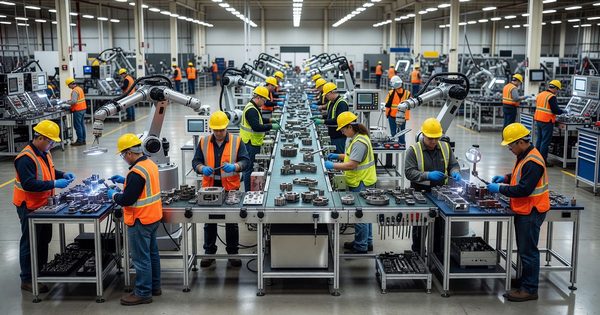
Every reshoring conversation in procurement circles eventually turns to tariffs, currency, and freight costs — the financial levers that make a domestic supplier look more or less competitive on paper. What gets discussed far less, and what actually determines whether a reshoring plan survives contact with reality, is whether the supplier can staff the line. Manufacturers who want to bring production back to the US routinely run into a wall that has nothing to do with policy: there simply aren’t enough people applying for the jobs.
The Scale of the Labor Gap
US manufacturers have reported hundreds of thousands of unfilled positions in recent years, and industry projections point toward the gap widening rather than closing over the coming decade as a large share of the existing skilled workforce reaches retirement age faster than replacements are trained. Multiple industry surveys and reshoring-tracking organizations have identified workforce availability — not tariff exposure, not logistics cost — as the single largest constraint preventing OEMs from reshoring production they say they would otherwise bring back to domestic suppliers.
This is a structural problem, not a cyclical one. It reflects decades of declining enrollment in vocational and technical training pathways, an aging skilled-trades workforce, and a persistent perception gap where manufacturing careers are underrepresented as an option for younger workers compared to service-sector or white-collar paths. Tariff policy can shift the financial calculus of where to source; it cannot manufacture a trained welder, CNC machinist, or industrial electrician out of thin air.
Wage pressure compounds the availability problem in a way that can quietly undermine a reshoring business case built on planning-stage assumptions. When several manufacturers in the same region compete for the same limited pool of qualified machinists, welders, and controls technicians, the going rate for those roles tends to rise — which means the domestic-labor cost a company modeled at the outset may understate what the supplier actually has to pay to fill and retain the positions. The constraint, in other words, is not only whether the workers exist but what it costs to secure them once multiple employers are bidding for the same scarce skills, and that dynamic tends to intensify precisely in the regions where recent reshoring investment has clustered. A buyer relying on a supplier’s early cost projections should recognize that those projections can erode if the supplier is forced into a bidding war for talent it assumed would be readily available.
Why This Matters More Than the Tariff Math
A procurement team evaluating a reshoring decision typically models landed cost, duty exposure, and lead-time risk with reasonable precision, because those variables are documentable and comparable across suppliers. Labor capacity is harder to model, which is exactly why it gets underweighted in sourcing decisions — right up until a supplier that looked financially attractive on the RFQ spreadsheet turns out to be operating at a fraction of nameplate capacity because it can’t staff a second shift, or is bleeding experienced machinists to retirement faster than it can backfill apprenticeships.
The practical consequence for a buyer is that a domestic supplier’s quoted capacity and its actual deliverable capacity can diverge significantly, and that divergence tends to surface only after volume has been committed — the worst possible time to discover it. A supplier that wins a contract based on optimistic capacity assumptions, then can’t staff the line to meet it, produces exactly the kind of lead-time and quality risk that reshoring was supposed to eliminate in the first place.
What “Made in USA” Capacity Claims Actually Require
Evaluating whether a domestic supplier can genuinely deliver at the volume and timeline it’s quoting requires looking past the marketing language around reshoring and asking specific, verifiable questions about the workforce behind the claim:
- Current headcount versus quoted-capacity headcount. Ask directly whether the facility is currently staffed to the level required to meet the volume being quoted, or whether meeting that volume assumes hires that haven’t happened yet.
- Time-to-fill for skilled positions. A supplier that has open requisitions sitting unfilled for months on skilled-trade roles is signaling a labor constraint that will affect delivery regardless of how confident the sales team sounds.
- Apprenticeship and training pipeline. Facilities that have invested in structured apprenticeship programs, partnerships with local technical colleges, or in-house training tracks are meaningfully better positioned to backfill retiring skilled workers than facilities relying purely on the open labor market.
- Overtime and second-shift dependency. A facility running at capacity primarily through overtime on an existing skeleton crew, rather than a fully staffed base shift, has less slack to absorb a demand spike or an unexpected departure.
- Regional labor market conditions. Facilities located in regions with tight manufacturing labor markets — often overlapping with areas that have seen recent reshoring investment concentrated in the same geography — face more competition for the same limited pool of skilled workers than facilities in less contested labor markets.
The Automation Question, and Why It Isn’t a Full Answer Yet
Automation investment is frequently offered as the solution to the labor constraint, and a meaningful share of US industrial firms report plans to expand automation specifically to offset workforce gaps. Automation genuinely can reduce headcount requirements for certain repetitive, well-defined production tasks, and a supplier actively investing in automation to offset labor risk is a meaningfully different proposition than one hoping the labor market improves on its own.
But automation is not a uniform substitute for skilled labor across all manufacturing processes. Complex assembly, quality inspection requiring judgment, and many precision-machining operations still depend on experienced human operators, and the capital and lead time required to automate a production line are themselves significant — a supplier promising automation-enabled capacity that hasn’t yet been installed is making a forward-looking claim, not describing current capability. Buyers should distinguish between automation already deployed and generating measurable output, versus automation investment that is planned or in progress.
There is also a workforce dimension to automation itself that buyers sometimes overlook. Automated cells still require skilled technicians to program, maintain, and troubleshoot them, so heavy automation tends to shift the labor requirement from line operators toward higher-skilled maintenance, robotics, and controls roles rather than eliminating dependence on skilled labor outright. Those higher-skilled roles are frequently harder to fill than the operator positions the automation replaced, which means a supplier that has automated aggressively but cannot retain the technicians who keep those systems running may simply have traded one labor constraint for another that is less visible on a plant tour. This is why the automation question is best treated as one component of a broader workforce-stability assessment rather than a separate box to check — the relevant question is not whether a supplier has automated, but whether it has the skilled staff to keep that automation productive over the life of a contract.
Building the Labor-Risk Question Into Supplier Evaluation
The practical fix is straightforward even though it requires more diligence than a standard capability audit: treat workforce stability as its own explicit line item in supplier qualification, not an assumed byproduct of financial and quality metrics. Ask for current staffing levels against quoted capacity, ask about time-to-fill on skilled roles, and ask what the supplier is actually doing — training pipelines, wage strategy, automation investment already in production — to address the constraint, rather than accepting a general assurance that staffing “isn’t a concern.”
A domestic supplier that can speak specifically and concretely to its workforce pipeline is demonstrating exactly the kind of operational maturity that makes reshoring pay off. One that can’t, or that deflects the question toward tariff savings and shipping-time advantages instead, is signaling that the labor constraint may not be fully priced into what it’s quoting.
Frequently Asked Questions
Why is labor availability a bigger constraint on reshoring than tariffs? Tariff exposure is a knowable, modelable cost that can be built directly into a landed-cost comparison. Labor availability is a capacity constraint that doesn’t show up in a standard RFQ response and often only becomes visible after volume has been committed, which is why industry surveys and reshoring trackers consistently identify workforce gaps as the primary barrier once companies actually attempt to reshore.
What questions should a buyer ask to evaluate a domestic supplier’s workforce risk? Ask for current staffing levels relative to the capacity being quoted, time-to-fill data on recent skilled-trade openings, whether the facility has a structured apprenticeship or training pipeline, and how dependent current output is on overtime versus a fully staffed base shift.
Does automation solve the manufacturing labor shortage? Automation can meaningfully reduce headcount needs for certain repetitive or well-defined tasks, and facilities investing in it are better positioned than those that aren’t. It is not a full substitute across all processes — complex assembly and judgment-dependent quality inspection still require skilled operators — and buyers should distinguish automation already in production from automation that’s merely planned.
How can I verify a supplier’s “Made in USA” capacity claim is real? Ask specific, verifiable questions rather than accepting the claim at face value: current headcount against quoted volume, time-to-fill on skilled positions, training pipeline investment, and whether output currently depends heavily on overtime. A supplier that answers these specifically is generally more credible than one that redirects to general reassurances.
Is the manufacturing skills gap expected to improve? Most industry projections point toward the gap widening over the next decade as a significant share of the existing skilled-trades workforce reaches retirement age faster than new workers enter the field, absent a substantial shift in vocational training enrollment or immigration and workforce policy.
Further Reading from Authoritative Sources
- Bureau of Labor Statistics — Manufacturing — BLS industry data on manufacturing employment, job openings, and labor turnover, providing the underlying federal data on the sector’s workforce trends.
- ISM — Institute for Supply Management — ISM’s manufacturing reports and supply-chain research provide primary-source context on capacity and sourcing conditions referenced throughout procurement industry analysis.