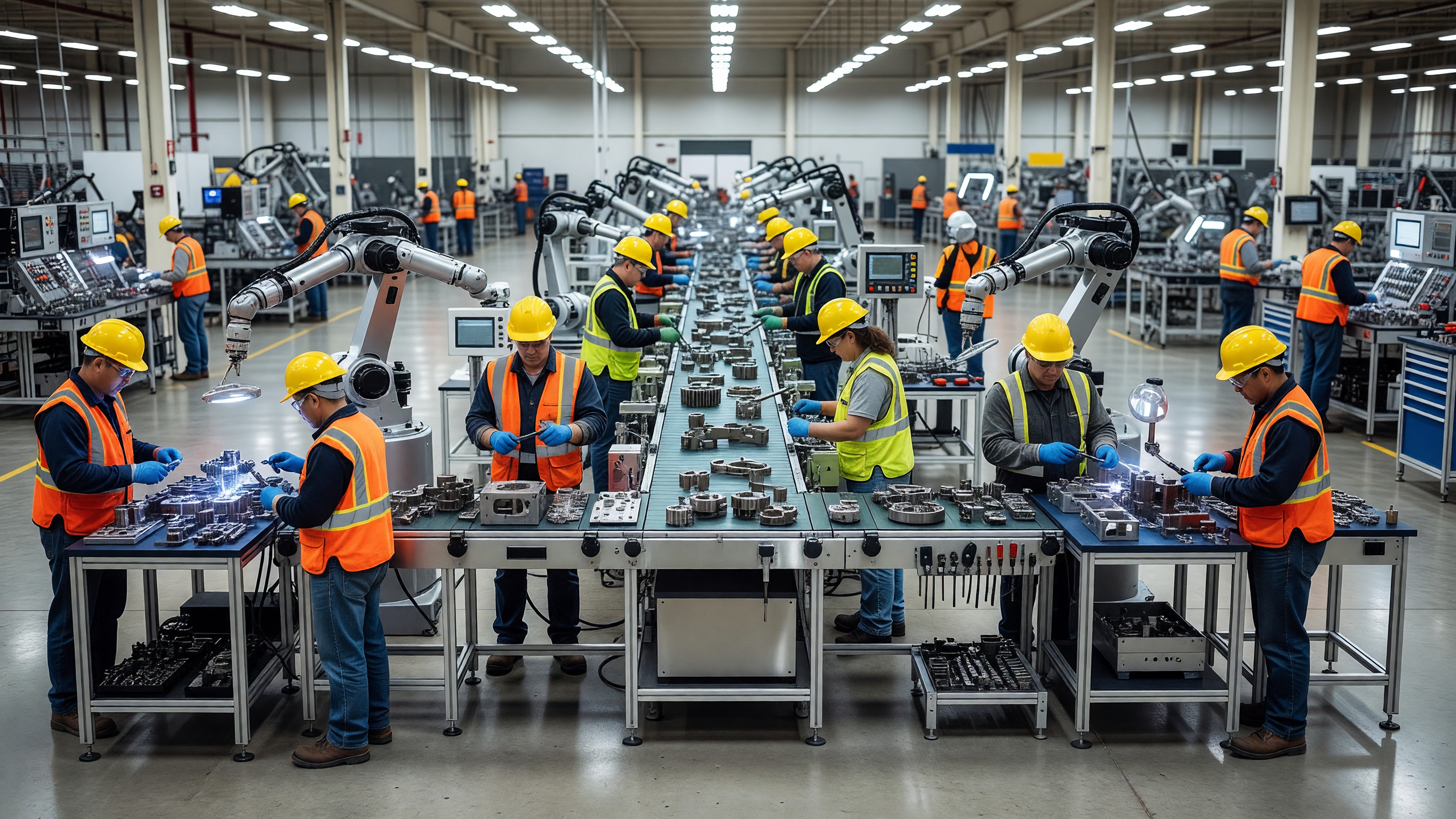
The tariff argument has always rested on a simple premise: raise the cost of imported goods, and domestic production fills the gap. One year after the April 2025 “Liberation Day” tariff package, procurement professionals have enough data to evaluate that premise honestly. The headline-level answer is uncomfortable — factory construction is up, announced jobs are up, and actual manufacturing employment is down. Understanding why that gap exists matters for anyone sourcing domestically or planning to.
What the Employment Numbers Actually Show
BLS data through April 2026 puts US manufacturing employment at approximately 12.6 million workers — about 9.3% of total private-sector employment. That number has not grown. According to the Progressive Policy Institute’s analysis of Labor Department figures, US manufacturing shed roughly 89,000 jobs over 2025. A separate Cato Institute review of BLS subsector data confirmed that manufacturing employment declined after the April 2025 tariff announcements, with job openings and hires also falling.
The Federal Reserve Bank of Kansas City found that sectors with higher import exposure saw greater reductions in hiring — the opposite of the predicted effect. Downstream manufacturers who depend on imported inputs (steel, aluminum, components) absorbed cost increases faster than any reshoring capacity could offset them.
The BLS diffusion index for manufacturing — which tracks whether more subsectors are expanding or contracting — registered 51.4 in March 2026, then pulled back to 47.2 in April. Below 50 means more subsectors are cutting jobs than adding them.
Who Gained, Who Lost
The exception was primary metals. Domestic steel and aluminum producers did add jobs, as intended — tariffs on those inputs directly benefited upstream producers. The problem is that primary metals employ a fraction of the workers that downstream fabricators, auto suppliers, and industrial equipment manufacturers do. Protecting 30,000 steelworker jobs while contracting 100,000 positions in downstream industries is not a net win for manufacturing employment.
The Announcement-to-Hiring Gap
Facility announcements tell a different story — and it’s not wrong, just incomplete. The Reshoring Initiative’s 2024 Annual Report, published June 2025, recorded 244,000 announced US manufacturing jobs in 2024 via reshoring and foreign direct investment. Q1 2025 showed tariff citations as a reshoring driver jumping 454% year-over-year.
The critical caveat: the Reshoring Initiative measures announced jobs, not filled ones. Since 2010, approximately 2 million manufacturing jobs have been announced via reshoring; roughly 1.7 million have actually been filled. The lag between announcement and hiring typically runs 12 to 24 months, and for capital-intensive semiconductor or EV battery facilities, it runs longer. A fab announced in 2025 that breaks ground in 2026 will hire production workers in 2028 at the earliest.
Early 2025 data projected a potential drop to 174,000 announced jobs for the full year — down from 244,000 in 2024 — reflecting uncertainty about tariff permanence. Major tentative announcements were contingent on clearer policy signals.
Capital Is Moving. Labor Is Not (Yet).
Private manufacturing construction spending tells the most dramatic story. From January 2021 to January 2025, it tripled — from $76.2 billion to nearly $230 billion annually. By October 2025, Census Bureau data put total manufacturing construction spending at $224.2 billion. Semiconductor investments drove a disproportionate share: TSMC committed $100 billion across three new Arizona fabs; Micron announced $200 billion across Idaho, New York, and Virginia; Nvidia pledged $500 billion in US AI infrastructure spending over four years.
The CHIPS Act had already primed this pipeline before tariffs arrived — over 30 companies across 45+ project locations have received preliminary or finalized CHIPS Program Office awards. The Trump administration’s “One Big Beautiful Bill Act” then raised the investment tax credit for domestic fab construction from 25% to 35% for projects breaking ground before December 31, 2026, accelerating the incentive stack further.
Capital deployment and employment are on different timelines. That distinction matters enormously for procurement planning.
The Workforce Problem Tariffs Cannot Solve
The Cleveland Fed published research in October 2025 asking a pointed question: if manufacturers do reshore, where will they find workers? The answer was not reassuring. Nearly 500,000 manufacturing positions currently sit unfilled because modern factories require digital operations, robotics programming, and AI-adjacent skills that existing training pipelines cannot supply at scale.
Reshoring Initiative survey data adds another dimension: OEMs said they would reshore 30% of their offshore production if skilled domestic labor existed. Tariffs at 15% only brought back 23% of that same production. Workforce availability is a harder constraint than input costs.
This is the structural problem that a tariff schedule cannot fix. A 145% tariff on Chinese electronics does not produce a trained PLC technician in Ohio. Apprenticeship pipelines, community college partnerships, and workforce development programs operate on decade-scale timelines. Tariffs operate immediately.
What This Means for Domestic Sourcing Decisions
Procurement teams evaluating domestic sourcing alternatives in 2026 should separate three distinct categories of supplier:
Established domestic producers — companies that were already manufacturing in the US before 2025 and have simply seen demand shift their way. These suppliers exist, can quote, and can ship. Capacity may be constrained; lead times and pricing have both moved.
Capacity-expansion reshoring — existing US plants adding lines or shifts. These are real but slow. A new production line takes 6 to 18 months to qualify, tool, and ramp. Announced capacity is not available capacity.
Greenfield reshoring — new facilities announced in 2025 or 2026. These are not procurement options for at least two to four years. Budget them as future optionality, not current supply.
The risk for procurement teams is treating press releases as supply chain alternatives. A Johnson & Johnson announcement of $55 billion in US manufacturing investment, or a Stellantis commitment of $13 billion, tells you about capital allocation strategy over a decade — not about what you can buy domestically in Q3 2026.
Reading the Data Without the Politics
The honest read of one year of tariff data looks like this: manufacturing construction investment is at historic highs, driven by a combination of CHIPS Act incentives, tariff-driven demand signals, and major corporate announcements. Actual manufacturing employment is lower than it was before the tariffs. The announced jobs pipeline is real but lagged by years. Downstream manufacturers — the ones who buy components — absorbed cost increases before reshoring alternatives existed.
For procurement professionals, the practical upshot is straightforward. Domestic sourcing options are expanding, but not at the pace the announcement cycle suggests. Qualify domestic suppliers now for categories where options exist. Build longer sourcing runways for categories where domestic capacity is still under construction. Price in tariff costs as a floor, not a ceiling — policy permanence is uncertain, but material cost increases are already embedded in supplier quotes.
The reshoring story is real. The timeline is not what the press releases suggest.