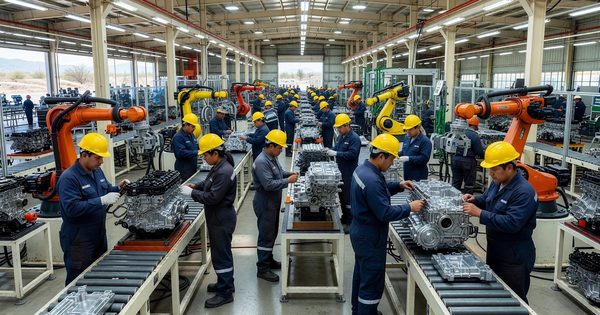
The shift in global manufacturing geography that accelerated through 2020–2024 is now showing in how procurement teams approach supplier selection. North American manufacturing capacity has expanded in several key categories, and buyers who built sourcing strategies around the assumption of offshore primacy are finding those assumptions worth revisiting.
This is not a story about tariffs alone — the forces driving reshoring and nearshoring are structural, and they affect how buyers should think about supplier qualification, lead time modeling, and total cost of ownership.
Which Sectors Are Leading the Reshoring Movement?
Not all manufacturing categories are reshoring at the same rate. The economic case varies significantly by product type.
Semiconductors and electronics have seen the most policy-driven investment, with major fab construction announcements in Arizona, Ohio, and Texas. For buyers, this matters less at the component purchasing level than at the system design level — the supply chain for assembled electronics still involves significant offshore content even when final assembly is domestic.
Industrial equipment and machinery has seen consistent reshoring activity, driven by lead time considerations more than cost. A custom conveyor system or industrial press that requires 14–20 weeks from an Asian manufacturer versus 8–10 weeks from a domestic fabricator changes the working capital equation significantly, particularly when demand forecasting is uncertain.
Building materials — especially those with high weight-to-value ratios — were never heavily offshore to begin with. Regional manufacturing dominates concrete products, structural steel fabrication, and dimensional lumber. The trend here is more about regional consolidation than reshoring.
Food and beverage manufacturing is overwhelmingly North American by regulatory and logistics necessity. Import requirements, cold chain constraints, and consumer labeling expectations make domestic production the default.
Automotive and transportation components are the most complex case. OEM supply chains rebuilt around Mexican manufacturing (USMCA-compliant) represent nearshoring rather than reshoring, and those supply chains are maturing rather than reversing.
Why the Total Cost Case for Reshoring Has Improved
Procurement professionals who evaluated reshoring exclusively on unit cost found the math unfavorable a decade ago. Several factors have changed that calculation.
Inventory carrying costs are visible now in a way they were not. When capital was essentially free, holding 90 days of offshore inventory was a rounding error. At current interest rates and with the risk premium many CFOs now assign to supply chain concentration, the cost of holding offshore inventory changes the total cost model.
Freight and logistics costs have reset at a higher baseline. The anomalous freight costs of 2020–2022 have normalized, but they normalized at rates significantly above the pre-pandemic baseline. Long-haul ocean freight and port disruption risk factor into total landed cost calculations at levels most procurement models did not include previously.
Labor cost differentials have compressed. Wage growth in manufacturing-heavy offshore markets, combined with automation investment that reduces direct labor content in North American facilities, has narrowed the labor arbitrage that historically justified offshore sourcing for many product categories.
Engineering change velocity matters more now. Products with shorter development cycles and frequent specification changes incur real costs when manufacturing is located far from engineering teams. The cost of a design change — in communication, tooling modification, re-qualification — is substantially higher with an offshore manufacturer 12 time zones away.
What Nearshoring via Mexico Looks Like in Practice
For many categories where full reshoring to U.S. or Canadian facilities is not cost-justified, nearshoring to Mexico under USMCA has become the middle path. The model combines lower direct labor costs with significantly shorter lead times than Asian manufacturing and simplified logistics.
Mexican manufacturing has moved well beyond simple assembly operations. Aerospace machining, medical device manufacturing, electronics assembly, and industrial component fabrication are all well-established in industrial corridors around Monterrey, Juárez, and Tijuana. Buyers who dismissed Mexico as a sourcing option based on the country’s manufacturing profile of 10–15 years ago should revisit that assumption.
The practical challenges of nearshoring involve compliance with USMCA rules-of-origin requirements, managing customs processes that are simpler than Asian imports but still require expertise, and finding qualified suppliers in a market where English-language sourcing information is less readily available than from Tier 1 Asian suppliers.
How Procurement Teams Should Adjust Their Supplier Strategies
For buyers building or rebuilding supplier portfolios, the shift in manufacturing geography suggests several adjustments:
Dual-source where it matters. The COVID supply disruption argument for single-source elimination has been well-understood for several years. The practical implementation — identifying and qualifying a second supplier — remains incomplete for many programs. Reshoring activity has created opportunities to establish domestic backup sources for programs that previously depended on sole-source offshore suppliers.
Update your total cost models. If your total landed cost analysis was built before 2020, the inputs for freight, inventory carrying cost, and exchange rate volatility likely understate the cost of offshore sourcing relative to current conditions.
Evaluate supplier financial health more rigorously. Reshoring investment is capital-intensive. Some suppliers are carrying significant debt from facility expansion or equipment investment. A supplier financial health review — not just a quality audit — should be part of supplier qualification for significant programs.
Factor lead time into new product development. Sourcing decisions made during product design determine lead time options for the life of the product. Procurement teams that are involved early in product development can influence supplier selection toward options that provide both cost competitiveness and shorter lead times.
Frequently Asked Questions
Is reshoring just a tariff response, or is it a permanent structural change?
Both. Tariff uncertainty has accelerated decisions that underlying economics were already making viable. But the structural factors — labor cost convergence, inventory carrying costs, engineering change velocity, and supply chain risk premiums — would be driving some reshoring activity regardless of trade policy. Most analysts expect the direction to persist even through policy changes.
Does reshoring make sense for consumer goods with cost-sensitive retail price points?
Generally less so than for industrial or capital equipment. Consumer goods with established offshore supply chains and highly price-sensitive retail positions face a harder reshoring economics case. The category where it does make sense is higher-value consumer goods where “Made in USA/Canada” carries a real price premium with buyers.
Where can I find North American manufacturers in specific product categories?
Industry directories organized by product category and capability are the most efficient starting point. Trade association member directories, regional manufacturing extension programs (MEPs), and industry-specific publications are also reliable sources. Government resources like the SelectUSA program maintain databases of domestic manufacturing capacity by sector.
How do I evaluate a supplier that is newly reshored or recently expanded capacity?
Treat it like qualifying any new supplier, but add questions specific to the transition: How long has the expanded facility been operational? Are key production personnel experienced in the product category, or are they being trained? What is the ramp timeline to full-rate production? New capacity announcements are not the same as proven production capability — qualify based on demonstrated performance, not plans.