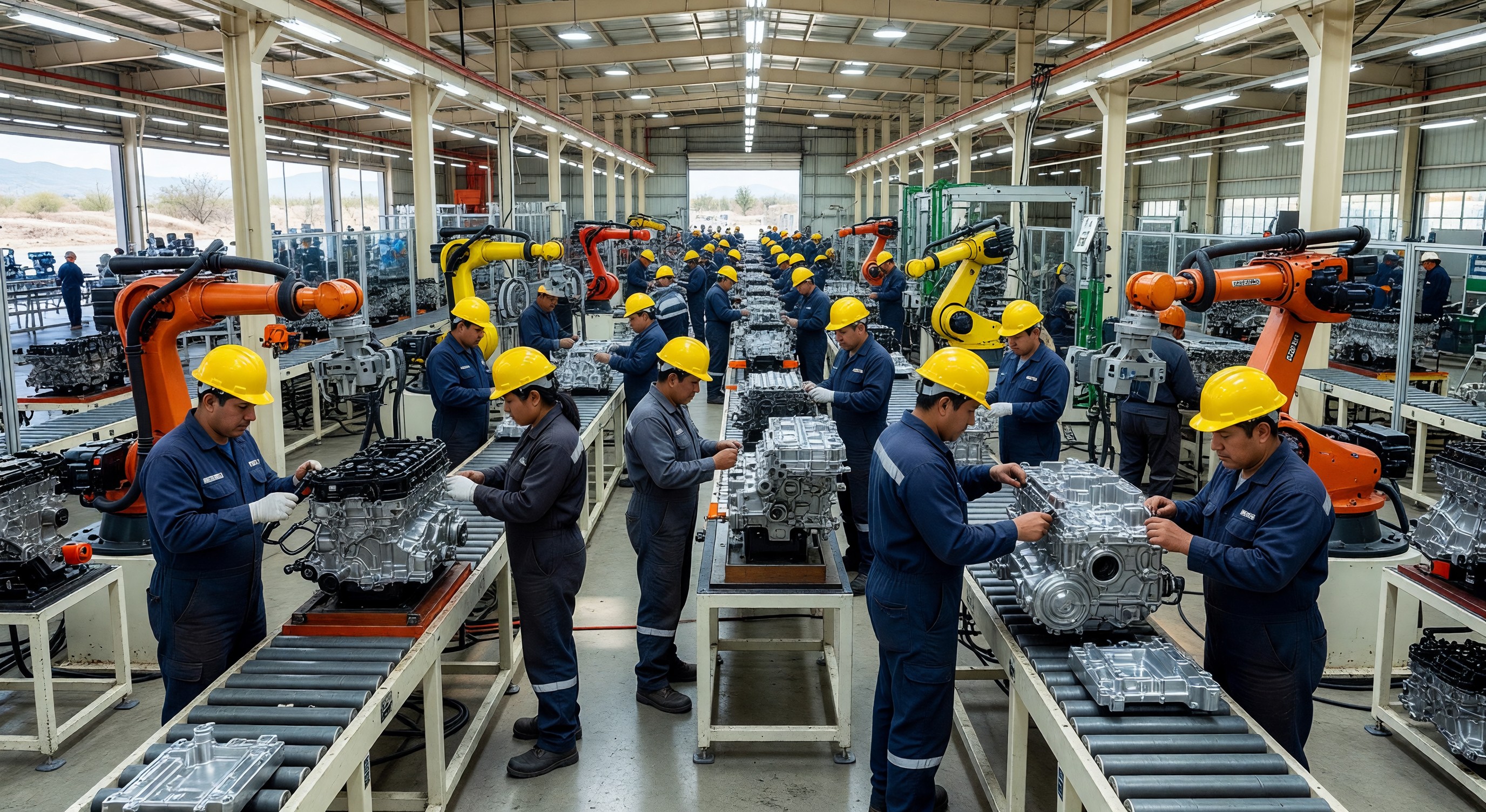
Mexico’s manufacturing sector has become one of the most significant stories in North American supply chain reconfiguration. As companies have re-evaluated offshore manufacturing in Asia — driven by tariff exposure, lead time concerns, and supply chain concentration risk — Mexico has absorbed substantial manufacturing investment across automotive, electronics, medical devices, and industrial equipment sectors.
For procurement teams considering nearshoring, the decision is more nuanced than it appears. Mexico offers genuine cost and logistics advantages, but the picture changes depending on sector, product type, and how the manufacturing relationship is structured. This guide covers what buyers and sourcing teams need to evaluate before moving production.
The Business Case for Mexico Nearshoring
The fundamental appeal of Mexico as a manufacturing location for U.S. companies rests on four factors:
USMCA cost advantages. The United States-Mexico-Canada Agreement, which replaced NAFTA in 2020, provides duty-free or significantly reduced duty treatment for goods meeting USMCA rules of origin. For eligible products, this eliminates the tariff differential that makes Chinese or Southeast Asian manufacturing more expensive than the unit price suggests. The Office of the United States Trade Representative publishes the current USMCA rules of origin requirements by product category.
Geographic proximity and logistics. A plant in Monterrey or Guadalajara is 2–5 days from the U.S. border by truck — compared to 4–6 weeks by ocean freight from Asia. This dramatically reduces safety stock requirements, enables just-in-time delivery programs, and allows faster response to engineering changes and demand shifts.
Labor cost. Manufacturing labor costs in Mexico are significantly lower than in the United States, though higher than in lower-cost Asian manufacturing locations. The advantage is in total landed cost: the logistics savings, duty savings, and inventory savings frequently more than offset the labor cost gap with Asia.
Time zone and cultural proximity. Coordinating production engineering, quality, and scheduling with a Mexican facility shares U.S. time zones — or overlapping working hours — which simplifies supplier management compared to managing across 12+ hour time differences.
The Maquiladora Model
The maquiladora program (formally the Manufacturing, Maquiladora and Export Service Industry program, or IMMEX program) is the primary vehicle for U.S. companies manufacturing in Mexico.
Under IMMEX, a company can temporarily import raw materials, components, and equipment into Mexico duty-free for use in manufacturing products that will be exported. The duty-free import applies to materials in the production process — when the finished product is exported, duties are waived on both sides (the Mexican import duty and, under USMCA, the U.S. import duty on re-entry).
The program has produced a significant manufacturing ecosystem, particularly in the border states of Chihuahua, Nuevo León, Baja California, and Tamaulipas. Industrial parks designed for IMMEX operations provide infrastructure — utilities, warehousing, logistics connectivity — that reduces the setup burden for new entrants.
Operating models within IMMEX:
Shelter manufacturing. A shelter company is an established Mexican entity that manages the IMMEX registration, HR, legal compliance, and facility operations on behalf of the foreign company. The foreign company focuses on production technology and quality — the shelter handles everything else. This is the lowest-risk entry for companies without prior Mexico manufacturing experience.
Full standalone operation. The foreign company establishes its own Mexican legal entity, obtains its own IMMEX registration, and operates independently. This provides maximum control but requires understanding Mexican labor law, environmental regulations, and administrative requirements.
Joint ventures and toll manufacturing. Some companies partner with established Mexican manufacturers rather than building new capacity. Toll manufacturing (contract manufacturing with buyer-supplied materials) is a middle path between full outsourcing and standalone investment.
Sectors With Established Mexican Manufacturing Infrastructure
Not all manufacturing categories have equally developed ecosystems in Mexico. The sectors with the most mature supply chains, available labor, and specialized industrial parks:
Automotive and transportation. The most established sector, with clustered supply chains around OEM facilities in Guanajuato, Nuevo León, and Coahuila. Automotive suppliers benefit from proximity to OEM assembly plants, deep Tier 1 and Tier 2 supply chains, and extensive IATF 16949 certification in the supplier base. Bureau of Labor Statistics research on North American auto supply chains documents the integration of U.S. and Mexican automotive production.
Electronics and electrical equipment. Juárez, Tijuana, and Monterrey have extensive electronics manufacturing infrastructure — EMS providers, PCB assembly, wiring harnesses, and subassembly facilities. The electronics sector includes both consumer electronics and industrial/commercial electronic equipment.
Medical devices. Mexico has established itself as a significant medical device manufacturing location, particularly in the Baja California and Nuevo León clusters. The sector benefits from FDA-regulated facilities that understand GMP requirements and have experienced labor in cleanroom and precision assembly operations.
Aerospace. Aerospace manufacturing in Mexico has grown rapidly, with Chihuahua, Baja California, and Querétaro hosting significant Tier 1 and Tier 2 aerospace suppliers. The aerospace cluster has developed certification infrastructure — AS9100, NADCAP-approved special processes — that supports demanding quality requirements.
Industrial equipment and machinery. Metal fabrication, machining, and industrial assembly have a broad footprint across Mexico, less clustered than automotive but available throughout the manufacturing-active states.
What Buyers Need to Evaluate Before Moving Production
Supplier qualification in Mexico. The ISO 9001 certification infrastructure in Mexico is well-developed, particularly in established manufacturing clusters. Verification follows the same process as any international supplier — use the certifying registrar’s database, not a certificate document. For automotive, the OASIS database confirms IATF 16949 certification.
Logistics infrastructure. Not all locations in Mexico have equal logistics infrastructure. Identify the nearest FAST (Free and Secure Trade) and C-TPAT-enrolled border crossings to your target facility. C-TPAT participation by your supplier reduces customs processing time and border crossing costs. The USMCA and established customs infrastructure make the U.S.-Mexico border one of the most efficient trading corridors in the world.
Labor law and workforce stability. Mexico’s labor law underwent significant reform in 2019, requiring companies using outsourcing to restructure worker relationships. Understanding the current employment structure requirements — and ensuring your manufacturing partner or shelter operator is compliant — is essential before committing to a manufacturing relationship.
Currency risk. Contracts denominated in Mexican pesos expose you to USD/MXN exchange rate risk. Many cross-border manufacturing agreements are denominated in USD, which shifts the currency risk to the Mexican manufacturer but may affect pricing stability.
IP protection. Mexico has strengthened IP protections under USMCA, including trade secret protections. For products with significant IP sensitivity, legal review of applicable Mexican IP protections and contractual provisions — NDAs, IP ownership clauses, restrictive covenants — is appropriate.
Comparing Mexico to Other Nearshore Options
Mexico is not the only nearshore option for U.S. buyers. Central American countries (Honduras, Guatemala, El Salvador) and Caribbean Basin CBTPA beneficiaries offer duty advantages for apparel and some other categories. For certain specialized manufacturing, Canada remains the highest-quality nearshore option with additional trade agreement protections.
However, for volume manufacturing across the broadest range of industrial categories, Mexico’s combination of scale, infrastructure maturity, USMCA eligibility, and logistics access is unmatched in the Americas. The decision to compare Mexico with other nearshore options is most relevant in apparel and low-complexity assembly, where lower-wage Central American options compete on labor cost.
Frequently Asked Questions
How do USMCA rules of origin affect whether a product qualifies for duty-free treatment?
Rules of origin define how much of a product’s content or transformation must occur within the USMCA region to qualify for preferential duty treatment. For manufactured goods, this typically requires a certain percentage of North American content (measured by regional value content) or a change in tariff classification from inputs to the finished product. Products that fail the rules of origin test pay the standard MFN tariff rather than the USMCA preferential rate.
Is a maquiladora (IMMEX) program necessary for sourcing from Mexican manufacturers?
Not necessarily. If you are purchasing from an established Mexican manufacturer rather than establishing your own production, you do not need your own IMMEX registration. The Mexican manufacturer may already operate under IMMEX. For USMCA duty preferences on the finished goods you import, the certification of origin requirements apply regardless of the Mexican manufacturer’s IMMEX status.
What is the typical lead time advantage of Mexican vs. Asian manufacturing for U.S. buyers?
The logistics lead time difference is 4–8 weeks for most product categories — 2–5 days by truck from Mexico versus 4–6 weeks by ocean from Asia. This allows proportionally lower safety stock, faster response to engineering changes, and more frequent, smaller order quantities. The total supply chain cycle time reduction is often 6–10 weeks.
How do I find qualified manufacturers in Mexico for a specific product category?
Industrial parks and shelter operators in established manufacturing clusters maintain directories of co-located manufacturers. Trade associations such as the American Chamber of Commerce in Mexico (AmCham Mexico) maintain member directories. The U.S. Commercial Service (part of the International Trade Administration) provides matchmaking services for U.S. companies seeking manufacturing partners in Mexico.
What quality certifications should I expect from Mexican manufacturers in industrial sectors?
For automotive, IATF 16949 certification is standard among Tier 1 and Tier 2 suppliers. For general industrial, ISO 9001 certification is the baseline. For aerospace, AS9100 certification and NADCAP approval for special processes is common in the established aerospace clusters. Certification infrastructure in Mexico’s major manufacturing clusters is comparable to U.S. and European supplier bases in these sectors.
Further Reading from Authoritative Sources
- Office of the United States Trade Representative — USMCA: Official USMCA text, rules of origin guidance, and implementing regulations for buyers evaluating Mexico manufacturing under the trade agreement.
- U.S. International Trade Administration — Doing Business in Mexico: The ITA provides market intelligence, supplier matchmaking, and trade compliance resources for U.S. companies expanding manufacturing relationships in Mexico.